How to Find a Painting from a Description When You Don't Know the Artist or Title
You remember the mood, the light, or the scene — but not the name. Here is a practical order of tools and tactics, from museum keyword search to semantic search and community identification.
How to Find a Painting from a Description When You Don't Know the Artist or Title
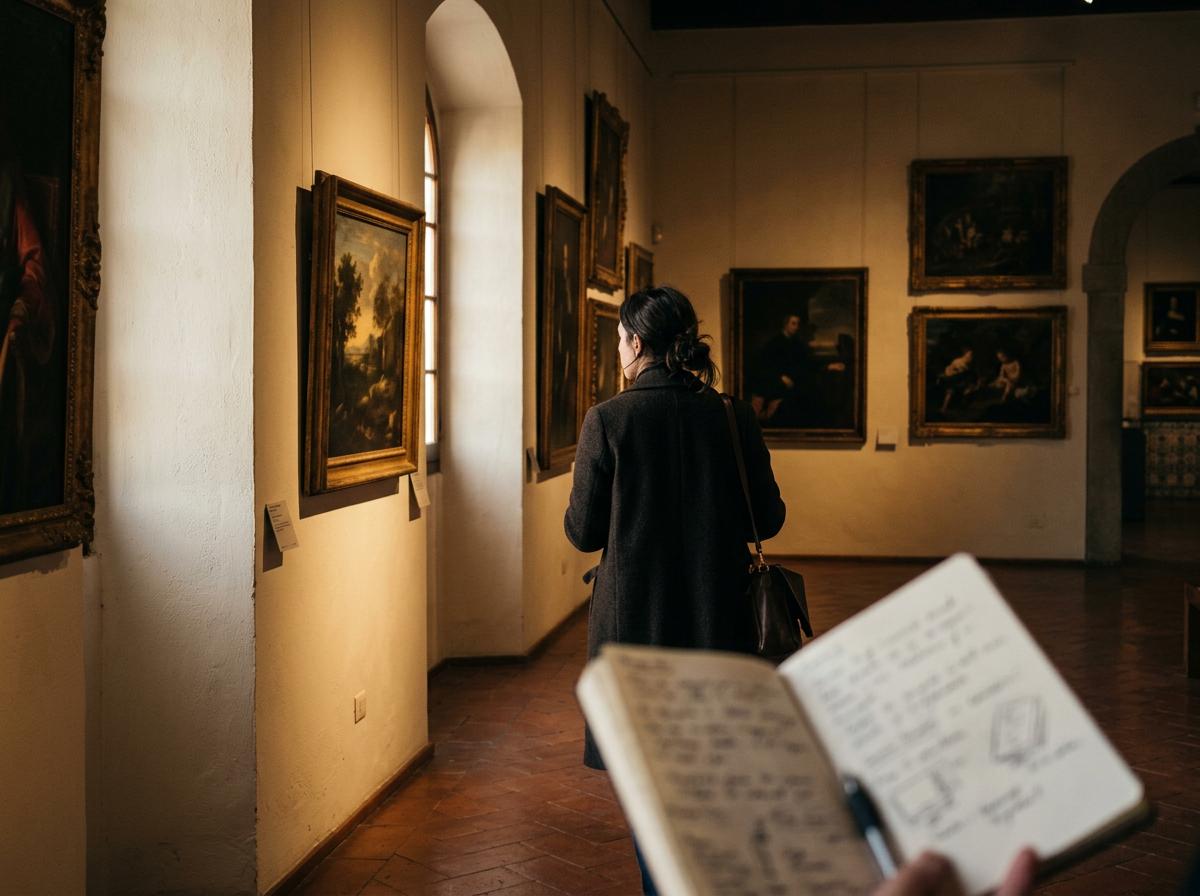
You saw a painting once — in a museum, a textbook, or online — and what stayed with you was not the title. It was the feeling. Warm window light on a woman reading. A ship in a storm at dusk. A solitary figure in candlelight.
Most museum search boxes were not built for that kind of memory. They were built for lookup: artist name, title fragment, accession number, medium, date range. If your description does not overlap with catalog vocabulary, you get nothing useful even when the work is in the collection.
This note is a practical guide to finding a painting from a written description alone — what to try first, what each approach is good at, and where semantic search fits.
Start with what you actually remember
Before opening a tool, write down everything you can, even if it feels vague:
- People and poses — alone, reading, mourning, dancing
- Objects — umbrella, ship, candle, letter, mirror
- Setting — interior, storm at sea, forest, city street at night
- Light and colour — golden afternoon, blue twilight, harsh candlelight
- Period or region — Dutch, Impressionist, 19th-century American (if you have a guess)
- Mood — melancholy, peaceful, eerie, sublime
The more visual detail you include, the better every method below will perform. Mood alone can work for semantic search; mood plus scene details works better everywhere.
Option 1: Museum keyword search (when you know the museum)
If you know the painting is likely in a specific collection, start with that museum's own search.
The National Gallery of Art search works well when you have an artist, title word, or classification term. It is less reliable for free-form descriptions like "woman holding umbrella in a field" unless those words appear in catalog metadata.
Best for: famous works, known artists, precise title fragments.
Weak for: half-remembered scenes, mood-led memories, descriptions in everyday language.
Option 2: Cross-museum metadata search
Tools such as Curationist search millions of artworks across hundreds of museums. Their strength is breadth — if the painting might be outside a single institution, a cross-museum index is the right next step.
Best for: subject-led descriptions with concrete nouns ("ship in storm", "woman with parasol in field").
Weak for: very abstract mood queries with few visual anchors, unless the platform supports semantic matching.
Option 3: Semantic search on a fixed collection
When keyword search fails, meaning-based search often outperforms metadata matching — especially for mood, light, composition, and scene memory.
Retrievals is a free semantic search tool over 68,816 open-access works from the National Gallery of Art. You type a natural-language description; the system embeds your words and every indexed artwork into the same vector space and returns visually and semantically similar results.
Example queries that work well:
- "melancholy figure alone by candlelight, Dutch interior"
- "stormy sea at night with a small boat"
- "woman reading in warm golden window light"
- "peaceful autumn forest in golden light"
How it works (briefly):
- Each artwork image is embedded with Qwen3-VL-Embedding-2B into a 1024-dimensional vector.
- FAISS HNSW (
IndexHNSWFlat) approximate nearest-neighbour search retrieves top candidates from all 68,816 vectors. - A Qwen3-VL cross-encoder reranker re-scores the shortlist before results are returned.
Retrievals is text-query only today — describe the painting in words. Image upload is not part of the public search UI yet. If you have a photo or screenshot, visual search apps (or posting the image to a community) are the better path.
Best for: NGA holdings, mood and scene memory, multilingual descriptions, vague visual impressions.
Weak for: paintings outside the NGA open-access dataset; highly specific historical narratives that are not visually obvious in the image.
Option 4: Ask a community
When automated search fails, human identification often succeeds. Subreddits such as r/WhatIsThisPainting regularly identify works from detailed written descriptions — especially when you include period, medium, and every visual detail you recall.
Best for: obscure works, prints after famous compositions, misremembered attributions.
Weak for: instant results; quality depends on how thoroughly you describe the work.
A practical order to try
| Step | Method | When to use it |
|---|---|---|
| 1 | Write out your full visual memory | Always — improves every tool |
| 2 | Known museum keyword search | You know which museum likely holds it |
| 3 | Cross-museum metadata search | Subject-led query, unknown institution |
| 4 | Retrievals semantic search | NGA may hold it; mood/scene/memory-led query |
| 5 | Community identification | Automated search returned nothing plausible |
What semantic search does not fix
Semantic search changes how you ask, not what is in the archive.
- If the painting is not in the indexed collection, no search engine will find it there.
- Semantic search excels at light, composition, subject, and atmosphere. It is weaker on obscure iconographic references unless they are visually obvious.
- "Best tool" depends on scope: cross-museum breadth (Curationist) vs deep semantic search within one strong collection (Retrievals for NGA).
Within those limits, the gap semantic search closes is real: the half-remembered image, the feeling you want to recreate, the scene you can describe but not name.
Try it
If your memory points toward the National Gallery of Art — or you simply want to explore by description — open Retrievals and describe the painting in plain language. No artist name required.
For how the underlying pipeline works, see About Retrievals and the journal post Why Museum Search Is Broken.