What Was the Dutch Golden Age? Why Its Art Looks So Stubbornly Ordinary
No saints, no kings, no battles: a woman weighing pearls by a window. The 17th-century Dutch Republic produced the first art market aimed at ordinary buyers, and you can still read that market in what the pictures show.
What Was the Dutch Golden Age? Why Its Art Looks So Stubbornly Ordinary
Stand in front of a 17th-century Italian painting and you are usually looking at someone important: a saint, a cardinal, a duke, a god. Stand in front of a Dutch painting from the same decades and you are looking at a woman weighing pearls by a window, a courtyard with a broom leaning against the wall, or a cow.
That change is the whole story. It was not a change in skill or in taste. It was a change in who was paying.
The short answer
The Dutch Golden Age was roughly a century of extraordinary output in the northern Netherlands, conventionally dated from the Dutch Republic's emergence around 1588 to the end of the century. In that window a small, wet, newly independent country of under two million people produced Rembrandt, Vermeer, Frans Hals, Jacob van Ruisdael, Pieter de Hooch, Judith Leyster, and several dozen more painters whose work still fills museum galleries.
It is called a golden age because of that concentration, not because the period was pleasant. It included war with Spain, war with England, plague, and in 1672 a national collapse so complete the Dutch still call it the rampjaar, the disaster year.
Three things changed at once
The Reformation removed the biggest client. Calvinist churches did not commission altarpieces. In Catholic Europe the Church was the single largest and most reliable buyer of pictures, and in the Dutch Republic that buyer simply switched off. Painters had to find someone else.
Independence and trade created someone else. Amsterdam became the hub of a trading empire, and the profits did not pool in a handful of aristocratic households. They spread across a wide merchant and artisan class with wall space and disposable income.
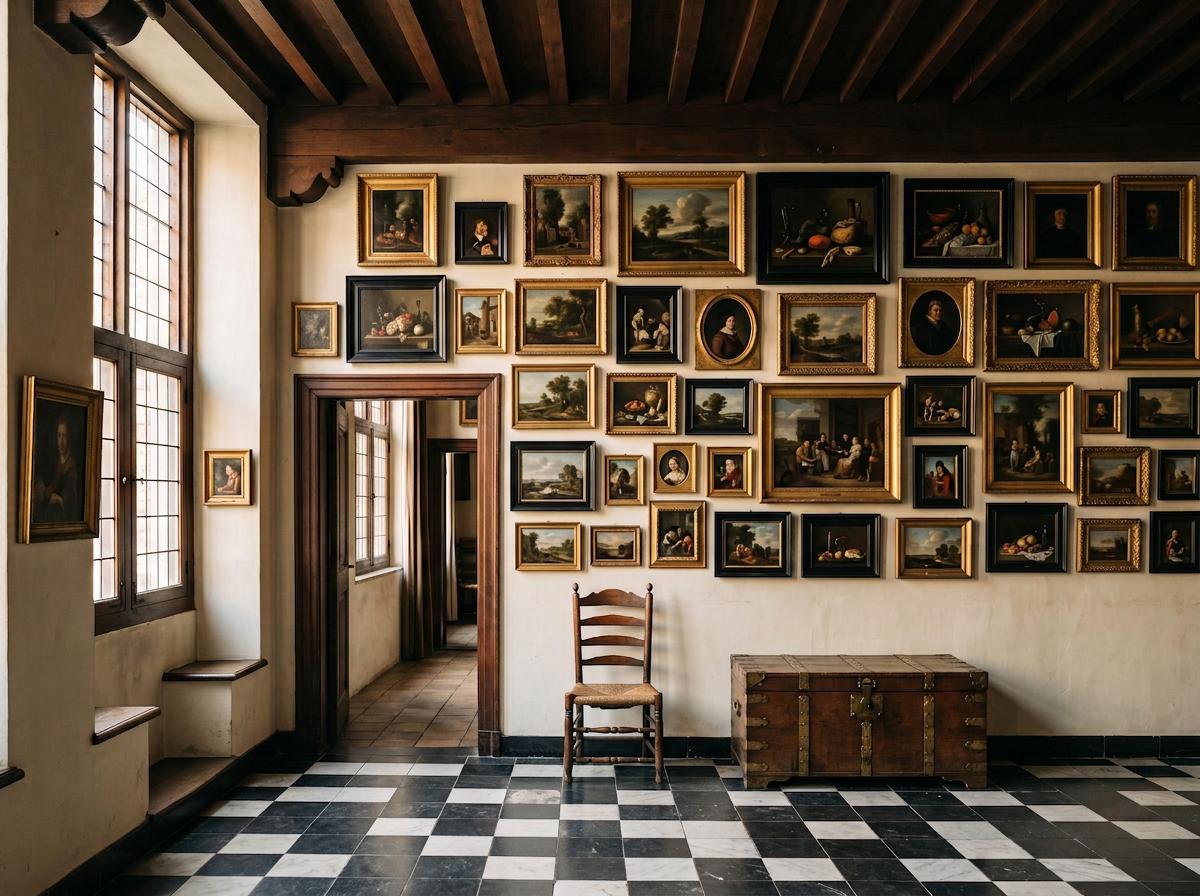
So the art market inverted. Instead of a patron commissioning a specific work in advance, painters made pictures speculatively and sold them through dealers, fairs, lotteries, and shops, to buyers they had never met. Inventories from the period show pictures hanging in the homes of bakers and blacksmiths. Foreign visitors remarked on it, usually with some bafflement at how many paintings ordinary Dutch houses contained.
What that did to the pictures
Every visual characteristic people associate with Dutch Golden Age art follows from that market rather than from a style manifesto.
They got smaller. A picture bought for a merchant's parlour has to fit a parlour wall. The vast canvases of Baroque Italy make no sense in a house on a canal.
They got secular. With no church commissions and no royal court, the subjects available were the ones buyers actually wanted to live with: their own faces, their own streets, their own countryside, their own possessions.
Painters specialised, hard. This is the part that surprises people. In a speculative market, a recognisable specialism is a brand. Willem van de Velde the Younger painted ships, with rigging accurate enough that naval historians still use his work as evidence. Jacob van Ruisdael painted weather. Pieter de Hooch painted sunlight crossing a tiled floor and passing through a second doorway beyond. You could build a career inside one subject because dealers and buyers knew what to come to you for.
And they carried a second layer. A woman reading a letter is rarely only a woman reading a letter. Period viewers read the objects: an untuned lute, a snuffed candle, a map on the wall, a mirror. The moral suggestion is folded into the ordinary scene rather than announced from a pulpit.
"Dutch realism" is the wrong phrase
These pictures get filed under realism, and the label misleads more than it helps.
Dutch painters were not documenting rooms. They were building them. X-rays and infrared studies of these panels routinely show chairs moved, doorways relocated, figures painted out, floor tiles redrawn to sharpen a perspective line. De Hooch's courtyards are assembled from parts of several real places. Vermeer's rooms are cleaner, emptier, and more geometrically obliging than any working household has ever been.
What is genuinely realist is the attention: the willingness to give an ordinary object the same care a Florentine painter gave a saint's face. The scene is constructed. The looking is honest. Calling it realism suggests the opposite of what actually happened.
What 459 Dutch works actually look like, counted
Retrievals indexes the National Gallery of Art's open collection, so rather than argue from the canon, I counted. Across the thirteen Dutch Golden Age painters on our movement hub the NGA holds 459 works, dated between 1626 and 1700. Two things in that number are worth staring at.
One artist is four fifths of the period. Rembrandt accounts for 373 of the 459. Vermeer accounts for three. Pieter de Hooch has four, Judith Leyster and Jan Steen two apiece. That lopsidedness is not a judgment about importance, it is a fact about printmaking: Rembrandt was a prolific etcher, editions survive in numbers, and unique panel paintings do not.
The period compresses into three decades. Of the 447 works we can date, roughly nine in ten fall between 1630 and 1659, peaking in the 1650s. A century-long "golden age" turns out, in one major collection, to be mostly thirty years.
Grouping those 459 works by subject (we do this by matching title text, so treat it as approximate) gives a rough shape of the period's output:
| Subject | Works |
|---|---|
| Biblical and narrative | ~86 |
| Landscape, marine, and winter scenes | ~74 |
| Portraits and self-portraits | ~32 |
| Domestic and genre scenes | ~22 |
Note the first row. Biblical subjects are the largest group, in the art of a republic that had abolished religious commissions. They did not vanish, they moved: out of churches, into homes, and above all into print, where a Rembrandt etching of the Prodigal Son cost a fraction of a painting and reached buyers who would never own a panel.
The missing genre
Here is the finding that surprised me most. Among all thirteen of those painters, the number of works with "still life" in the title is zero.
The still life is arguably the signature Dutch invention: the lemon peel, the half-drunk glass, the tulip past its best, the skull. Across the NGA's full collection there are 79 works with "still life" in the title. None of them belong to the thirteen names most people would list if you asked them to name Dutch Golden Age painters.
The reason is that the still life was itself a specialism, and its specialists are a different roster: Willem Claesz Heda, Jan Davidsz de Heem, Willem Kalf, Ambrosius Bosschaert. The NGA holds them in ones and twos rather than in depth.
This is worth knowing whenever you use any museum collection to learn about a period. A collection is not a survey. It is the residue of what particular donors bought and gave, and it will quietly overweight some artists and drop whole genres. Our own hub page inherits that bias, and now you know where.
Looking at them without knowing the names
The practical problem with a period like this is that its subjects are ordinary, so its titles are unhelpful. "Interior with a Woman", "A Dutch Courtyard", and "The Bedroom" describe half the output between them, and catalogue search needs you to already know which words the cataloguer chose.
Describing what you can see works better. Try "sunlight through an open doorway onto a tiled floor" or "woman reading a letter by a window in a quiet room" in find a painting by description, and the pictures come back without a single proper noun in the query. If you have a specific painting you are trying to put a name to, identify a painting is the same idea pointed at that problem.
Some places to start looking:
- Pieter de Hooch, for the doorway-and-daylight construction: A Dutch Courtyard and The Bedroom
- Johannes Vermeer, all three NGA panels: Girl with the Red Hat, Woman Holding a Balance, A Lady Writing
- Frans Hals, for the loosest brushwork of the century: Portrait of a Woman Aged Sixty
- Rembrandt van Rijn, for the self-portraits as a record of ageing: Self-Portrait of 1659
- Jacob van Ruisdael, for weather doing the emotional work: The Three Oaks and Forest Scene
Or browse the whole period by subject on the Dutch Golden Age hub, which is organised the way the painters organised themselves: by what they specialised in.